Space Quest III: The Pirates of Pestulon
Last updated: November 12, 2026
Overview
Space Quest III: The Pirates of Pestulon is a graphic adventure game developed and published by Sierra On-Line, released on March 24, 1989 for MS-DOS, with the Atari ST port coming out in April, the Amiga version in October, and the Macintosh version in 199112.
Designed by Mark Crowe and Scott Murphy, the game is the third installment in the Space Quest series and the first Space Quest game to use Sierra’s SCI engine13.
The game continues the misadventures of Roger Wilco as he becomes involved in rescuing a pair of computer programmers—the game’s own creators—from a sinister video game company1.
Game Info
Developer: Sierra On-Line2
Designer: Mark Crowe, Scott Murphy2
Publisher: Sierra On-Line2
Engine: SCI0 (Sierra Creative Interpreter)12
Platforms: MS-DOS, Amiga, Atari ST, Macintosh
Release Year: 1989
Series: Space Quest
Protagonist: Roger Wilco
Sierra Lineage: Core Sierra
Story Summary
After the events of Space Quest II, Roger Wilco lies in cryosleep in his drifting escape pod4. An automated garbage freighter scoops it up, and Roger wakes among the trash, a fitting spot for a janitor-turned-hero4.
Searching for a way out, Roger finds a derelict ship, the Aluminum Mallard, in the freighter’s hold, repairs it and flies it out4. On the desert planet Phleebhut he is confronted by a Schwarzenegger-like android terminator sent to collect on the whistle he never paid for in the previous game; Roger outwits it and takes its invisibility belt4.
At an orbiting Monolith Burger, a hidden message in an arcade game reveals that its programmers, the “Two Guys”, have been kidnapped by ScumSoft, a sinister software company run by Elmo Pug, leader of the “Pirates of Pestulon”, which plans to force them to churn out terrible games4.
Deciding to rescue them, Roger visits the volcanic planet Ortega to disable the force field generator that hides its small moon, Pestulon5. On Pestulon, Roger uses the invisibility belt to slip into the ScumSoft base and disguises himself in janitor’s overalls4. He finds the Two Guys but is caught by Elmo, who makes him fight in an arena of giant robots modelled on Rock ‘Em Sock ‘Em Robots; Roger wins and escapes with the Two Guys4.
After beating off a squadron of ScumSoft ships, the trio find the warp drive broken4. Tinkering with it, with no course set, sends them through a black hole into another dimension and out in front of Earth4. Roger delivers the designers to Sierra On-Line president Ken Williams, is turned down for a janitorial job, and heads home4.
Gameplay
Space Quest III was developed using an early version of Sierra’s SCI engine4, replacing the AGI engine used for the first two games6. SpaceQuest.net’s writer thought the 16-colour graphics “come close to 256 color VGA in some parts”7.
Interface and Controls
- PC versions support mouse movement and a heavily improved text parser17
- Mouse movement was still basic: Roger simply stops when he walks into an obstacle rather than pathing around it4
- The parser understands “almost every word you type”7
- Unlike previous games, players can no longer choose the protagonist’s name—from this game onward, the character is permanently known as Roger Wilco4
Structure and Progression
- The game takes place across multiple locations including the garbage freighter, the desert planet Phleebhut, the orbital Monolith Burger station, the volcanic planet Ortega, and ScumSoft headquarters on Pestulon45
- The highest possible score is 738 points8; Dragon’s 1989 review counted 728 possible points9
- The game includes various science fiction allusions, including wrecks of a TIE fighter, an ACME Rocket, and the Jupiter 2 spacecraft visible in the garbage freighter4
- Pestulon, the moss-covered moon where ScumSoft is headquartered, is probably a pun on Star Wars’ jungle moon Yavin IV, which sat behind an uninhabitable gas giant10
- The USS Enterprise warps away from Monolith Burger as Roger arrives, a Star Trek reference11
- Ken Williams and Rick Cavin cameo as whip-wielding overseers in ScumSoft’s programmer cubicles; Ken also appears in the ending sequence11. SpaceQuest.net calls Cavin Sierra’s Head of Production at the time11, Wikipedia calls him director of operations4, and in a Spring 1989 interview Bob Siebenberg refers to him as Sierra General Manager12
Puzzles and Mechanics
- The game includes Astro Chicken, an arcade minigame in which the player tries to land a chicken on a trampoline, playing much like Lunar Lander4
- Sierra Chest lists three arcade sequences: Astro Chicken, a robot fighting game called Nukem Dukem, and a space ship arcade shooter3; Games International’s Amiga reviewer likewise counts “three arcade-type sequences”, which he found “rather easy” after a few attempts13
- A high enough Astro Chicken score reveals a distress message hidden by the Two Guys from Andromeda4
- Sierra released Astro Chicken as a standalone demo for Space Quest III on the Sierra BBS14
- Anti-frustration feature: The hidden message in Astro Chicken also appears after failing 10 times, for players who can’t master the arcade gameplay15
- Unwinnable trap: Buying anything other than the
7 kid's meal at Monolith Burger means missing the decoder ring needed to progress—the only hint is that7 matches what you find in the Aluminum Mallard15 - SpaceQuest.net notes that “some say the game was a little bit too short and/or easy to beat”7
Reception
Contemporary Reviews
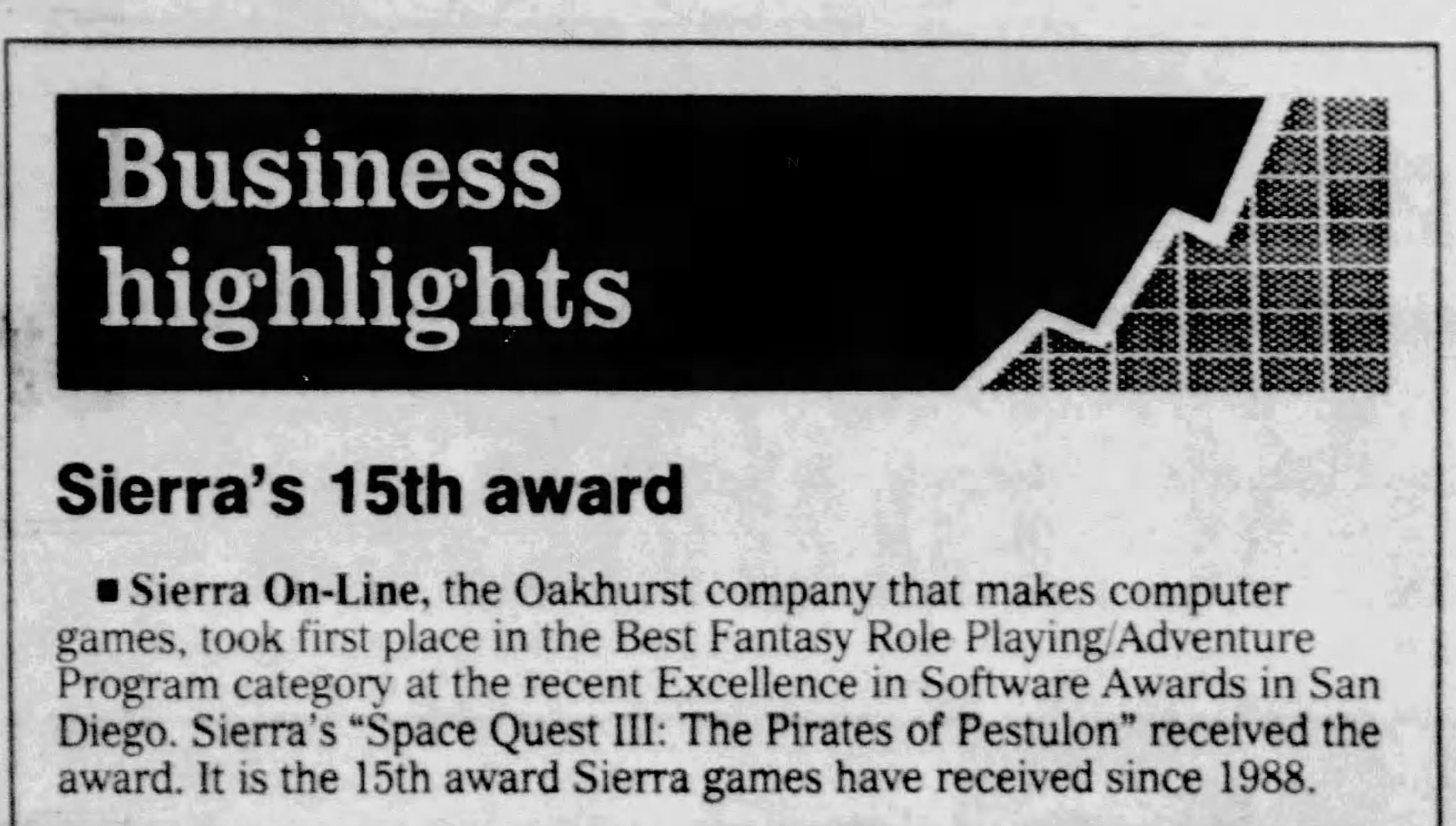
Space Quest III took first place in the Best Fantasy Role Playing/Adventure Program category at the 1990 Excellence in Software Awards16. Dragon gave the game 4 out of 5 stars4. C&VG gave the Atari ST version 83%, calling it “enjoyable and addictive”4. Dragon Magazine (September 1989) praised the game, stating that “the animation and graphics for this game are incredible” and concluding “This game is a lot of fun, and we recommend it to adventure game enthusiasts”9.
Compute! praised the game’s graphics and sound card audio, calling it “the best-looking game in the series” that “sounds as good as it looks, thanks to a 30-minute musical score”17. STart also praised the ST version’s graphics and sound, while warning that Space Quest III was “essentially a text adventure” with syntax guessing and frequent saved game reloading, but described it as “playable and not-too-difficult” and suitable for those new to adventure games18.
Computer Gaming World’s Chris Lombardi gave the game a positive review, noting the “marked improvement over its predecessors in most aspects” with “EGA graphics on the IBM are some of the best from Sierra to date”19. In 1989, CGW gave it a Special Award for Achievement in Sound—the first time the magazine gave an award specifically for sound in a computer game20. Game Player’s PC Strategy Guide awarded Space Quest III their 1989 “Best PC Adventure Role-Playing Game” and “Best PC EGA Graphics” awards, with the latter presented to Mark Crowe4.
Reviewing the Amiga version, John Scott of Games International called the program “BRILLIANT! The graphics are super” and thought the musical soundtrack was “the best I have yet encountered in any computer game”13. He noted the streak of humor running through the game, saying “Sometimes it’s warped, sometimes it’s cruel, but it’s always funny,” awarding it 9 for both Game Play and Graphics13.
Modern Assessment
- MobyGames: 7.9 combined MobyScore; critics 81% (26), players 4.0/5 (133)2
- GOG: 4.3/5 (collection)21
- Steam: Very Positive, 85% of 337 reviews (collection)22
- GameFAQs: rated “Great” (71 ratings)23
- HowLongToBeat: about 3 hours main story24
In a retrospective for Hardcore Gaming 101, Kurt Kalata called it “a clever, immensely likable game overall” but faulted its “extremely fussy” parser positioning, called both minigames “extremely clumsy”, and found the game “ruthlessly short”, with “only three locations to visit (four, once you uncover Pestulon)”25.
Development
Origins
Development took a little over a year—longer than the 9-11 months for the previous games—due to the team learning the new SCI system6. The SCI engine offered double the resolution of AGI, allowing greater detail and depth perception effects, though this meant graphics took significantly longer to create6.
The game features over 30 minutes of music composed by Supertramp drummer Bob Siebenberg176. Siebenberg composed the music based on videotaped game scenes, similar to film scoring6. Mark Seibert created the sound effects using a Roland MT-32 synthesizer (equivalent to 8 synthesizers combined), though loading custom sounds added 45 seconds to game startup6. It was one of the first games to support the Sound Blaster sound card47.
Sound effects include digitized audio sampling, such as the voice of Roger saying “Where am I?” during the introduction4. The digitized effects can be heard in the Tandy, Amiga, and Macintosh versions4.
The original game came with: a box, three 3.5” game disks (four for Amiga) or six 5.25” disks, manual, Andromedan snout and glasses complete with Death Ray Shield, SCI reference card, registration card, soundcard promotional brochure, letter from Ken Williams explaining the new soundcards, “please note” leaflet with technical information, Adlib coupon offering 20 rebate, optional hint book for 7.95, and Sierra games catalogue7. The PC/MS-DOS version was originally sold for $59.95199.
Production
Mark Crowe and Scott Murphy designed and wrote the game, and Crowe also made the graphics1. Bob Siebenberg told Sierra’s newsletter that he got the job after reading an advertisement in the Sierra Star, a local paper, for someone who knew how to work with MIDI; he met Rick Cavin, and the outcome was that he would write music for some of the new games12. He said Sierra supplied a Macintosh, a Mastertracks Pro and an MT-32, which he used alongside his own equipment in his home studio, and that Crowe and Murphy gave him a VHS cassette of what the game looked like12. He singled out “Festers Theme” as a light and funny piece12.
Development Credits:1
- Design and Writing: Mark Crowe and Scott Murphy
- Graphics: Mark Crowe
- Programming: Mark Crowe, Ken Koch, Scott Murphy, Doug Oldfield and Christopher Smith
- Game Development System: Robert Eric Heitman, Pablo Ghenis, Stuart Goldstein and Jeff Stephenson
- Music: Bob Siebenberg
- Music System: Stuart Goldstein
- Sound Effects: Mark Seibert
- Amiga Version: Dan Foy and Jim Heintz
- Atari ST Version: Corey Cole
- Macintosh Version: John Hartin, John Rettig and John Crane
- Macintosh Art: Nate Larsen, Steve Coallier and Jeff Crowe
- Documentation: Bridget McKenna
- Box Design: John T. Shaw
Technical Specifications
- Engine: SCI012
- Graphics: 16-colour palette at 320x200 resolution26
- Sound: Roland MT-32, Sound Blaster and AdLib supported26
- ScummVM: rated “Excellent”, first listed in its 1.2.0 compatibility chart2726
Debug Modes and Cut Content
- Debug cheat: Typing “pump shark” or “backstage pass” enables debug mode; then typing “get life” in the ScumSoft corridor grants the janitor disguise, vaporizer, keycard, and copy of Elmo’s picture, skipping much of the ScumSoft sequence2829
- SCI debugger: Holding both Shift keys and pressing numpad minus (-) activates Sierra’s internal SCI debugger for memory inspection29
- Unused graphics: Data mining revealed cut content including Arnoid’s invisibility belt activation sprites (replaced with a cutscene), Roger’s Astro Chicken hat walking animations (only front view used), alternate button designs for navigation/combat screens, and Roger’s disintegration frames (replaced with “ZOT!” text effect)29
- Hidden dialogue: Mark Crowe has an impossible-to-trigger line (“Just between you and me, I think Ol’ Wilco’s been in space too long”) that only appears after your ship is destroyed during the Skull Fighter attack—viewable only via debug mode teleport29
Easter Eggs and Trivia
- Astro Chicken origins: The minigame was inspired by Doug Oldfield’s program originally called “Chicken Lander”30
- MT-32 easter egg: The Roland MT-32 sound module displays “INSERT BUCKAZOID” after quitting the game30
- Hidden signature: Mark Crowe’s signature appears hidden somewhere in every copy of the game30
- Postcards: The postcard rack at Fester Blatz’s World o’ Wonders holds several spoof postcards, including Arrakis (Dune) and Acheron (Alien)31
- “Hey Trashmouth!”: One of the parser’s stock replies is “Hey, trashmouth! Don’t be saying that shit!”32
- Boss button prank: The “Boss” menu option cuts to black and shows pop-ups revealing the player’s total play time, warning that their boss wouldn’t be happy15
- Fourth wall break: After their rescue, one of the Two Guys can ask, “So, how do you like the game so far? Was it worth $59.95?”32
- Vomit gag: Eating the Big Belcher at Monolith Burger causes Roger to step behind the ship and vomit before takeoff15
- Van Halen reference: Roger’s case number with the Gippazoid Novelty Company is “OU812,” referencing Van Halen’s 1988 album of the same name31
- Promotional video: The real Two Guys from Andromeda appear in an SQ3 promo segment from Sierra’s 1988 Video Catalog VHS tape, battling through Sierra’s offices before ending up captured in a ScumSoft basement14
Bugs and Continuity
- Houdini bug: In the Garbage Freighter, typing “climb ladder” instead of “climb neck” causes Roger to disappear and reappear climbing onto the Mallard’s roof30
- Continuity error: Arnoid chases Roger for an unpaid whistle that was clearly stated to be free in SQ2—the 400,000 buckazoid debt is explained as accumulated interest15
- Lighter tone: Unlike other entries, ScumSoft’s evil plan is simply releasing crummy video games rather than galaxy-scale destruction15
Version History
| Version | Date | Platform | Notes |
|---|---|---|---|
| Original | March 24, 1989 | DOS | Initial release13 |
| Original | April 1989 | Atari ST | Port by Corey Cole12 |
| Original | October 1989 | Amiga | Port by Dan Foy and Jim Heintz12 |
| Original | 1991 | Macintosh | Port by John Hartin, John Rettig and John Crane12 |
| Early release | — | — | Cockpit computer reads “Lite Speed” instead of “Light Speed”30 |
| 1.018 | — | — | Version supplied with the Space Quest Collection30 |
Technical Issues
- The inclusion of an incorrect audio driver left the digitized effects unavailable to IBM PC users with the Sound Blaster card4. Hardcore Gaming 101, by contrast, says the “Where am I?” clip plays on a Tandy or Mac, or with Sound Blaster support enabled25
- The game can halt at startup with “Unable to initialize your audio hardware”, a timer problem that Sierra Help fixes by running it in DOSBox or patching the old audio driver with GOSiERRA or SBSIERRA33
- The Sierra Fandom Wiki lists an unofficial 1.1 patch by Commander Proton (also known as Proton Power) that fixes bugs and oversights and adds minor quality-of-life changes, plus a fixed Sound Blaster driver and an MTBLAST patch that allows MT-32 music with Sound Blaster sound effects1
Legacy
According to Sierra On-Line’s SEC filing, combined sales of the Space Quest series surpassed 1.2 million units by the end of March 199634.
In 1996, Computer Gaming World listed the player’s body parts being sold at a butcher shop as #2 on its list of “the 15 best ways to die in computer gaming”35. Several fan remake attempts were cancelled over the years; in 2003, a non-playable VGA demo was released, and in 2023, a fan remake titled Space Quest 3D was released4. Time Extension reported that the free remake comes from the Australian company TurboChimp, previously the developer of Mercury Blue, with voice acting by Mike Holmes and a redone soundtrack by Space Quest Historian and J.P. Sapsford; its developers announced it as available on June 2, 202336.
Collections
This game has been included in the following collections:
- Space Quest: Collector’s Edition (a.k.a. Roger Wilco Unclogged)3
- Space Quest Saga (The)3
- Space Quest Collection (XP)322
- Space Quest: Collection Series3
- Space Quest Trilogy (The)3
- Sierra’s Value Pack 33
- Space Quest 1+2+321
Downloads
Purchase / Digital Stores
Manuals & Extras
- Space Quest III Manual (PDF)37
- Space Quest III Hint Book (PDF)37
- Andromedan Glasses – pack-in feelies37
- Sierra Chest – Space Quest III – walkthrough, maps, easter eggs, memorabilia3
- MobyGames – Space Quest III – covers, screenshots, credits2
- Wikipedia – Space Quest III – encyclopedia article4
- PCGamingWiki – Space Quest III – technical fixes38
- HowLongToBeat – Space Quest III – completion times24
- StrategyWiki – Space Quest III – game guide26
- SpaceQuest.net – Space Quest 3 – game information, screenshots, soundtrack7
- SpaceQuest.net – SQ3 Point List – complete scoring breakdown8
- SpaceQuest.net – SQ3 Cameos – Ken Williams, Rick Cavin, Enterprise11
- SpaceQuest.net – SQ3 Fun Facts – easter eggs, bugs, trivia30
- Sierra Help – Space Quest III – patches, DOSBox tips, technical help33
- ScummVM Wiki – Space Quest III – engine compatibility, installation notes39
- The Cutting Room Floor – Space Quest III – debug modes, unused graphics, cut content29
- TVTropes – Space Quest III – tropes, parodies, gameplay analysis15
- GameFAQs – Space Quest III – guides, FAQs, user ratings23
- Virtual Broomcloset – Two Guys SQ3 Interview – Spring 1989 Sierra Newsletter interview6
- StrategyWiki – SQ3 Minigames – Astro Chicken, Dukem Nukem Robots, Space Battle40

See Also
- Space Quest Series
- ← Previous: Space Quest II: Vohaul’s Revenge
- → Next: Space Quest IV: Roger Wilco and the Time Rippers
- 1986 - Space Quest - The Sarien Encounter
- 1991 - Space Quest I - Roger Wilco in the Sarien Encounter
- 1993 - Space Quest V - The Next Mutation
- 1995 - Space Quest 6 - Roger Wilco in the Spinal Frontier
References
Footnotes
-
Sierra Fandom Wiki – Space Quest III – plot, technical details ↩ ↩2 ↩3 ↩4 ↩5 ↩6 ↩7 ↩8 ↩9 ↩10 ↩11 ↩12 ↩13 ↩14
-
MobyGames – Space Quest III – developer, publisher, platforms, credits, ratings ↩ ↩2 ↩3 ↩4 ↩5 ↩6 ↩7 ↩8 ↩9 ↩10 ↩11
-
Sierra Chest – Space Quest III – Sierra history, collections, platforms ↩ ↩2 ↩3 ↩4 ↩5 ↩6 ↩7 ↩8 ↩9 ↩10
-
Wikipedia – Space Quest III – C&VG 83% review, Game Player’s awards ↩ ↩2 ↩3 ↩4 ↩5 ↩6 ↩7 ↩8 ↩9 ↩10 ↩11 ↩12 ↩13 ↩14 ↩15 ↩16 ↩17 ↩18 ↩19 ↩20 ↩21 ↩22 ↩23 ↩24 ↩25 ↩26 ↩27
-
SpaceQuest.net – SQ3 Planets – Ortega (volcanic), Pestulon as Ortega’s small moon hidden by Ortega’s force field generator ↩ ↩2
-
Virtual Broomcloset – Two Guys SQ3 Interview – a little over a year of development, SCI learning curve, Bob Siebenberg film scoring approach, Mark Seibert sound effects ↩ ↩2 ↩3 ↩4 ↩5 ↩6 ↩7
-
SpaceQuest.net – Space Quest 3 Game Information – release details, original packaging, awards ↩ ↩2 ↩3 ↩4 ↩5 ↩6 ↩7 ↩8
-
SpaceQuest.net – SQ3 Point List – highest possible score 738 ↩ ↩2
-
Dragon Magazine – September 1989 (Issue 149) – Lesser family review, PC/MS-DOS version $59.95: “animation and graphics for this game are incredible”, “This game is a lot of fun, and we recommend it to adventure game enthusiasts” ↩ ↩2 ↩3
-
Space Quest Fandom Wiki – Pestulon – location details, Star Wars parallel ↩
-
SpaceQuest.net – SQ3 Cameos – Ken Williams, Rick Cavin, USS Enterprise references ↩ ↩2 ↩3 ↩4
-
The Sierra Newsletter, Vol. 2 No. 1, Spring 1989 – “From Supertramp to Space Quest III: An Interview with Bob Siebenberg” by Kirk Green (Internet Archive scan) – Sierra Star advertisement, Rick Cavin as “Sierra General Manager”, equipment, VHS cassette, “Festers Theme”; the same text is transcribed as InterAction Issue 5 at InterAction Magazine Archive ↩ ↩2 ↩3 ↩4
-
Games International #14 (April 1990) – John Scott review of the Amiga version, p. 46 (issue dated April 1990, though the archive file is named GI_14_May_1990): “This program is BRILLIANT! The graphics are super”, “musical soundtrack that is the best I have yet encountered in any computer game”, “Sometimes it’s warped, sometimes it’s cruel, but it’s always funny”, GAME PLAY: 9, GRAPHICS: 9 ↩ ↩2 ↩3
-
SpaceQuest.net – SQ3 Demo – Astro Chicken standalone demo (Sierra BBS), 1988 Sierra Video Catalog promo with the Two Guys ↩ ↩2
-
TVTropes – Space Quest III – tropes, fourth wall breaks, continuity errors, gameplay mechanics ↩ ↩2 ↩3 ↩4 ↩5 ↩6 ↩7
-
The Fresno Bee, April 2, 1990, p. 40 – “Sierra’s 15th award” (Virtual Broomcloset scan) – first place, Best Fantasy Role Playing/Adventure Program, Excellence in Software Awards ↩
-
Compute! – November 1989 (Issue 114) – “best-looking game in the series”, “sounds as good as it looks, thanks to a 30-minute musical score” ↩
-
STart Magazine – January 1990 (Issue 29) – David Plotkin review: “excellent graphics and animation”, “playable and not-too-difficult adventure”, “essentially a text adventure” warning, MIDI support praise ↩
-
Computer Gaming World – August 1989 (Issue 62) – Chris Lombardi review, pp. 36-37, PRICE: $59.95: “marked improvement over predecessors”, “EGA graphics…some of the best from Sierra to date”, parser improvements ↩ ↩2
-
Computer Gaming World – October 1989 (Issue 64) – 1989 Awards issue: “Special Award for Achievement in Sound” (first time CGW gave this award for sound), Bob Siebenberg score “perfectly captures the silly, tongue-in-cheek nature” ↩
-
GOG – Space Quest 1+2+3 – purchase, user reviews; 4.3 average from 578 ratings as of November 11, 2026 ↩ ↩2 ↩3
-
Steam – Space Quest Collection – purchase, user reviews ↩ ↩2 ↩3
-
GameFAQs – Space Quest III – user ratings, guides ↩ ↩2
-
HowLongToBeat – Space Quest III – completion times ↩ ↩2
-
Hardcore Gaming 101 – Space Quest III – Kurt Kalata, September 11, 2017: “ruthlessly short”, “only three locations to visit (four, once you uncover Pestulon)”, “extremely fussy” parser, “a clever, immensely likable game overall”; Sound Blaster and “Where am I?” clip remark ↩ ↩2
-
StrategyWiki – Space Quest III – game guide ↩ ↩2 ↩3 ↩4
-
ScummVM – Compatibility (1.2.0) – Space Quest III rated “Excellent” ↩
-
Space Quest Historian – 11 Things You Probably Didn’t Know About Space Quest – debug cheats, development trivia ↩
-
The Cutting Room Floor – Space Quest III – SCI debugger, unused graphics, hidden dialogue, debug commands ↩ ↩2 ↩3 ↩4 ↩5
-
SpaceQuest.net – SQ3 Fun Facts – Astro Chicken origins, MT-32 easter egg, hidden signature, bugs ↩ ↩2 ↩3 ↩4 ↩5 ↩6 ↩7
-
SpaceQuest.net – SQ3 Spoofs and References – “OU812” case number, World o’ Wonders postcards ↩ ↩2
-
Space Quest Fandom Wiki – SQ3 transcript – game text dump: “Hey, trashmouth! Don’t be saying that shit!”, “Was it worth $59.95?” ↩ ↩2
-
Sierra Help – Space Quest III – system requirements, known issues, DOSBox configuration ↩ ↩2
-
SEC Filing – Sierra On-Line 10-K (March 1996) – “Space Quest… sold more than 1.2 million copies in this series” ↩
-
Computer Gaming World – November 1996 (Issue 148) – “The Best Ways To Die in A PC Game” list: #2 Space Quest III, “body parts moving down a conveyor belt to be sold at the local butcher shop” ↩
-
Time Extension – Space Quest III Gets 3D Fan Remake Complete With Voice Acting – Jack Yarwood, June 5, 2023: TurboChimp, Mike Holmes, Space Quest Historian and J.P. Sapsford, free download ↩
-
Virtual Broomcloset – Publications Archive – manuals, hint books, pack-in feelies ↩ ↩2 ↩3
-
PCGamingWiki – Space Quest III – technical specs, fixes ↩
-
ScummVM Wiki – Space Quest III – ScummVM 1.2.0 support, SCI engine, resolution specs ↩
-
StrategyWiki – Space Quest III Minigames – Astro Chicken, Dukem Nukem Robots, Space Battle ↩