Stunt Flyer
Last updated: November 15, 2026
Overview
Stunt Flyer is a stunt-flying simulation for the Commodore 64, which MobyGames dates to September 19851. Sierra advertised it in October 1985 as a “professionally designed” simulator “for precision aerobatics”2, and its reference card billed it as “The Precision Aerobatics Flight Simulator”3. The player flies a small prop-plane at an airshow and tries to perform a set of airplane stunts1. The game was programmed by Nice Ideas of Sophia Antipolis, France, and published by Sierra On-Line41. According to the retro blog Retro365, which draws on a Gamotek interview with programmer Patrick Aubry, it was Sierra’s first published game developed in Europe5.
The plane is a Pitts Special biplane, which Compute!‘s Gazette called “the most maneuverable of all stunt planes”67. The manual’s note from the designers says, “Professional stunt pilots have evaluated it to ensure that it realistically simulates a real-life stunt plane”4. The player flies from a first-person cockpit view, and a side-scrolling 2D view replays the stunts afterwards18.
The game’s Competition Mode had a feature the Space Quest Omnipedia calls “a notorious feature”: crashing the plane there also crashed the program9. Sierra’s own InterAction magazine later said the feature brought “lots of angry letters from customers and a game with a very short software store shelf life”10.
Game Info
Developer: Nice Ideas14
Designer: Not credited
Programmer: Patrick Aubry (built the flight model and scoring routine, per Retro365)115
Publisher: Sierra On-Line, Inc.1
Engine: Unknown12
Platforms: Commodore 64111
Release Year: 198511113
Series: Standalone
Protagonist: Player (Stunt Pilot)
Sierra Lineage: Sierra Published
Story Summary
Stunt Flyer is a flight simulation built around skill, so it has no traditional storyline. The player is an airshow stunt pilot1. Beginners can watch an airshow to see how expert pilots fly the stunts, and then practise their own6.
The longer-term goal was Sierra’s own contest. Sierra’s October 1985 advertisement said the Sierra Stunt Flyer Competition “pits you against the best in the country for a chance to experience the real thing - airborne with a champion stunt flyer!”2 The manual says that a player becomes eligible “once you have completed at least 15 maneuvers with a minimum score of 50%”4.
Gameplay
Interface and Controls
The player flies from a first-person cockpit view, with gauges to help control the stunts1. The reference card’s instrument panel includes an air speed indicator, attitude indicator, altimeter, tachometer, turn coordinator, heading indicator, vertical velocity indicator, G meter and position indicator3. The plane can be flown from the keyboard or with a joystick in Control Port 2. Even with a joystick, the rudder and throttle stay on the keyboard, and the card advises that “for better precision, keyboard control is recommended”31.
The designers made two simplifications to the real aircraft. The torque effect of the propeller was left out, and only the front view is available, even though real stunt planes usually allow at least three. The manual warns that maneuvers needing more than a forward view, such as a vertical climbing roll, are therefore hard to fly accurately4.
Structure and Progression
MobyGames lists 20 stunts in total114, and the manual likewise lets the player pick an individual stunt to watch “from among 20 maneuvers” (p. 21)4. The reference card speaks of “the 20 specific stunts which make up the training sequence”3. Each attempt is scored on how closely it follows the ideal stunt, and the player can also watch an expert fly the stunts or fly a freestyle routine1. The Gazette listed slow rolls, hammerheads, half-loops, Immelmans “and even the outside-inside Cuban 8” among the maneuvers. In its words, “The stunts are not easy to master, but that’s the challenge”6.
Completing at least 15 maneuvers with a score of 50% or better unlocks the competition4. In the competition the player flies a 14-maneuver compulsory sequence within five minutes, then a freestyle sequence of no more than 60 seconds4. Both scores are saved to a separate blank disk4. The Gazette explained that this “competition” disk was then mailed to Sierra6.
Puzzles and Mechanics
Stunt Flyer has no traditional puzzles. Its challenge comes from the flight model. The 47-page manual covers the basic principles of aerodynamics and shows how to combine individual moves into an aerobatics sequence6. Its lessons run from the four basic maneuvers (slow roll, inside loop, hammerhead and spin) through Aresti-card sequence planning42.
According to Retro365, Aubry wrote a routine that scored each figure by how closely it followed the ideal flight curve5. After a stunt, the flight is replayed from the side and judged. As the Gazette put it, “If your flying is up to par, you’ll hear the spectators below applaud your efforts”61.
Reception
Contemporary Reviews
Compute!‘s Gazette reviewed the game in its January 1986 issue (David Florance, p. 55). It called the competition “the most enjoyable thing about Stunt Flyer”. It also said the game was “for those who like excitement in their software. There won’t be any dull moments”6. The review listed the price as 24.95 on disk[^ref-16]. The October 1985 issue of the *Computer Entertainer* newsletter likewise gave a list price of 24.95, described watching an expert fly “twenty aerobatic maneuvers” and noted that the keyboard “offers more precise control” than the joystick15.
The competition crash feature looked worse in hindsight. In 1994 Sierra’s InterAction magazine described Stunt Flyer as “perhaps the one game that Ken Williams heavily evangelized that he would now rather forget”. It said the crash-the-software feature produced angry customer letters and a short shelf life10.
Modern Assessment
There is little modern commentary on the game. On Lemon64, the only user comment (by Frightmare, March 31, 2025) rates it 6/10. The commenter wrote: “I hadn’t the patience to master the controls, but I must admit that watching the replay of the flight is pretty entertaining and probably the best part of the game”11.
Aggregate Scores:
- Lemon64: 6/10 (1 vote)11
Development
Origins
The manual credits the game as “Programmed by Nice Ideas, Sophia Antipolis, France”4. Retro365 reports that Nice Ideas was the former French office of Mattel Electronics, which became independent in 1984. It also reports that Patrick Aubry, who had studied aeronautics, spent a full year modelling the Pitts Special and its aerobatic maneuvers5. Lemon64 credits Aubry as the coder11.
Production
Retro365 reports that Aubry made a 4,000-mile trip from France to California late in development. There he spent two weeks with Sierra and with aerobatic pilot and flying coach Alan Gerringer (spelled “Geringer” by Retro365)5. The manual credits Gerringer as “Aerobatic Consultant”4.
Compute!‘s Gazette gave the manual as 47 pages6. The scanned manual’s numbered pages also run to page 47 (the warranty)4. Retro365 gives 48 pages5. The manual credits Annette Gerth Childs as its author4.
- Programming: Nice Ideas (Patrick Aubry, credited as coder by Lemon64)
- Aerobatic Consultant: Alan Gerringer
- Instructional Manual: Annette Gerth Childs
Voice Cast
The game has no voice acting.
Technical Achievements
According to Retro365, the most significant technical feature was the scoring routine, which compared each flown figure with an ideal flight curve5. The game pairs the first-person 3D flying view with a side-scrolling 2D replay of the same flight1.
Technical Specifications
- Perspective: 1st-person cockpit view, side view replay
- Visual Style: 2D scrolling
- Pacing: Real-time simulation
- Interface: Direct control (keyboard or joystick in Port 2)3
- Media: Disk6
Cut Content
No cut content has been documented for the Commodore 64 release.
Version History
| Version | Date | Platform | Notes |
|---|---|---|---|
| Original release | 1985 | Commodore 64 | MobyGames gives September 19851; advertised in RUN, October 19852 |
Sources disagree on the release year. InterAction (1994), Sierra Gamers and The Sierra Chest give 1983101612. The October 1985 advertisement, the January 1986 Gazette review (which calls it “Sierra’s new action software”) and MobyGames all point to 1985261. The manual itself carries the line ”© 1985 Sierra On-Line, Inc.” (p. 47)4.
Technical Issues
The best-known “issue” was deliberate. In Competition Mode, crashing the plane also crashed the software. The manual warns, “Be very careful! If you crash your plane during the competition, you will have to reboot”4. InterAction explains that Ken Williams “thought this would give players the feel that they were really risking a lot doing ‘death defying maneuvers.’”10
Easter Eggs and Trivia
- According to Retro365, it was the first published title developed in Europe for Sierra On-Line5
- According to Retro365, Patrick Aubry made a 4,000-mile trip from France to California during final development5
- The flight model is based on the Pitts Special aerobatic biplane67
- Sierra offered a
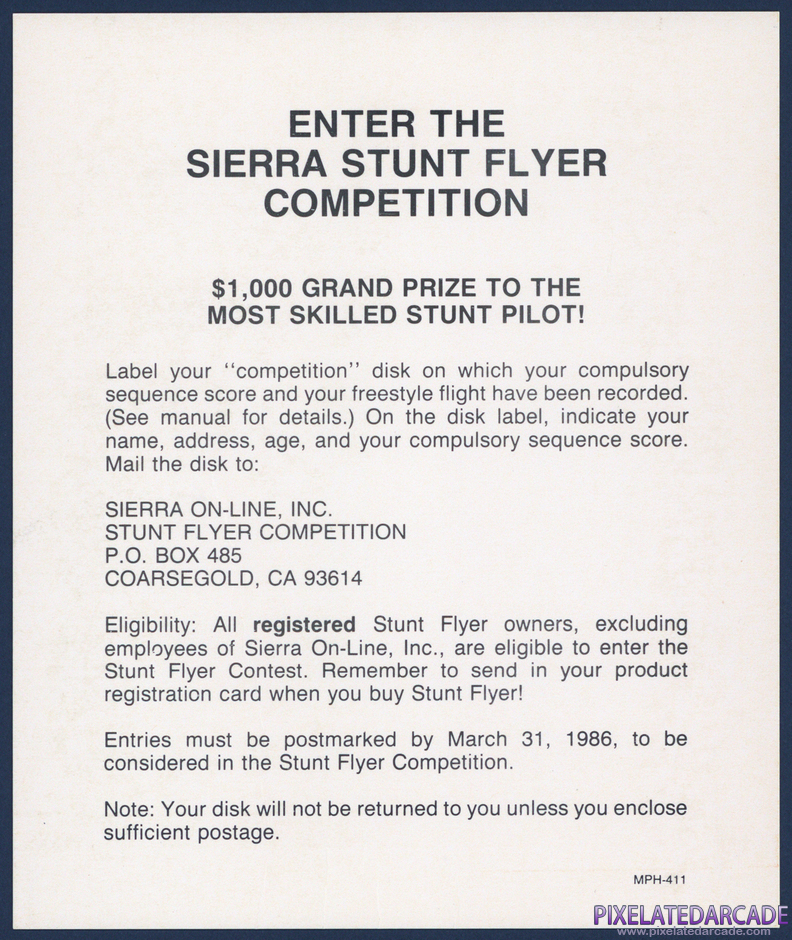
1,000 prize to the best Stunt Flyer pilot[^ref-16]. The competition card packed with the game offered a "1,000 Grand Prize to the most skilled stunt pilot” and said entries had to be postmarked by March 31, 1986, with disks mailed to a Sierra post office box in Coarsegold, California17 - Space Quest IV contains an unused “Bargain Bin” item for Stunt Flyer at the Software Excess store, which fans found in the game’s data189. The Space Quest Omnipedia transcribes its box text as a joke about the original game’s crashing (“Still looking for a sim that really crashes?”) and gives it a fake former title, “Hero’s Flyer”9
Legacy
Sales and Commercial Impact
No sales figures have been found. InterAction said the crash feature left the game with “a very short software store shelf life”10. The game was still remembered in 1990, when Computer Gaming World’s review of Accolade’s Blue Angels named “Sierra’s Stunt Flyer” among the stunt-capable aircraft products that followed Sublogic’s Flight Simulator19.
Collections
No compilations featuring Stunt Flyer have been documented.
Fan Projects
The Space Quest Omnipedia reports that NewRisingSun’s Space Quest 4 CD Version Update restored the unused Stunt Flyer bargain-bin item9.
Related Publications
- Game Manual: 47-page instruction manual by Annette Gerth Childs, with a separate reference card643. PixelatedArcade’s release listing (catalog number SRL-823, 5.25” disk, 1985) shows the package also held a competition card, and a warranty registration card20
Critical Perspective
Writing in 1994, InterAction used Stunt Flyer as a cautionary “then” example in a feature on how Sierra’s flight simulations had changed, saying Ken Williams would now rather forget it10. Retro365 describes it as Sierra’s first published game developed in Europe5, and in 1990 Computer Gaming World still named it among the stunt-capable flight products that followed Sublogic’s Flight Simulator19.
Downloads
Purchase / Digital Stores
- Not currently available on modern digital storefronts
Download / Preservation
- None listed
Manuals & Extras
Community Resources
See Also
- 1985 - Sierra Championship Boxing
- 1987 - 3-D Helicopter Simulator
- 1991 - Space Quest IV - Roger Wilco and the Time Rippers
References
Footnotes
-
MobyGames – Stunt Flyer – September 1985 Commodore 64 release, Nice Ideas developer, Sierra publisher, 20 stunts, 1st-person and side-scrolling replay modes, keyboard or joystick ↩ ↩2 ↩3 ↩4 ↩5 ↩6 ↩7 ↩8 ↩9 ↩10 ↩11 ↩12 ↩13 ↩14 ↩15 ↩16 ↩17 ↩18 ↩19
-
RUN Magazine, Issue 22 (October 1985) – Sierra Stunt Flyer advertisement – “Try flight stimulation”; the competition “pits you against the best in the country” ↩ ↩2 ↩3 ↩4 ↩5
-
Stunt Flyer reference card (Commodore 64), scan hosted by PixelatedArcade – “The Precision Aerobatics Flight Simulator”, the instrument panel, keyboard and joystick controls ↩ ↩2 ↩3 ↩4 ↩5 ↩6 ↩7
-
Stunt Flyer instruction manual (Commodore 64), scan hosted by PixelatedArcade – credits, note from the designers, competition rules (pp. 43–44), contents to p. 47 ↩ ↩2 ↩3 ↩4 ↩5 ↩6 ↩7 ↩8 ↩9 ↩10 ↩11 ↩12 ↩13 ↩14 ↩15 ↩16 ↩17 ↩18 ↩19
-
Retro365 – Stunt Flyer, the first game from Europe – 2023 blog post citing a Gamotek interview with Patrick Aubry: Nice Ideas history, the year-long Pitts Special modelling, the 4,000-mile trip, Alan Geringer, the scoring routine, the competition deadline, and “first published game developed in Europe” ↩ ↩2 ↩3 ↩4 ↩5 ↩6 ↩7 ↩8 ↩9 ↩10
-
Compute!‘s Gazette, Issue 31 (January 1986), p. 55 – “Stunt Flyer” review by David Florance – Pitts Special, maneuvers, 47-page manual, competition disk,
1000 prize,24.95 (disk) ↩ ↩2 ↩3 ↩4 ↩5 ↩6 ↩7 ↩8 ↩9 ↩10 ↩11 ↩12 -
Wikipedia – Pitts Special – the aerobatic biplane modelled in the game ↩ ↩2
-
PixelatedArcade – Stunt Flyer – overview, credits, and hosted scans of the manual and reference card ↩
-
Space Quest Omnipedia – Stunt Flyer – unused SQ4 bargain-bin item, box-text transcription, restoration in NewRisingSun’s CD Version Update ↩ ↩2 ↩3 ↩4
-
InterAction Magazine, Vol. VII No. 1 (Fall 1994), “That was then, this is now… Flight Simulation” – Sierra’s own retrospective on Competition Mode crashing the software, the angry letters, and the short shelf life ↩ ↩2 ↩3 ↩4 ↩5 ↩6
-
Lemon64 – Stunt Flyer – 1985, coder Patrick Aubry, aerobatic consultant Alan Gerringer, Frightmare’s 6/10 comment (March 31, 2025) ↩ ↩2 ↩3 ↩4 ↩5 ↩6 ↩7 ↩8 ↩9
-
The Sierra Chest – Stunt Flyer – catalog entry: Commodore 64, engine “Unknown/unnamed”, first release 1983-01-01, developer listed as Sierra On-Line (both conflict with period sources) ↩ ↩2
-
IGDB – Stunt Flyer – database entry, “Stunt Flyer (1985)”, “A precision aerobatics flight simulator” ↩
-
LaunchBox Games Database – Stunt Flyer – 1985, Commodore 64, 20 stunts (description mirrors MobyGames) ↩
-
Computer Entertainer, Vol. 4 No. 7 (October 1985) – Stunt Flyer review – “twenty aerobatic maneuvers”, Pitts Special, keyboard “offers more precise control”, “at least 15 maneuvers with a minimum score of 50%”,
1000 contest, MSR24.95 ↩ -
Sierra Gamers – Stunt Flyer – fan catalog entry (lists release date as 1983) ↩ ↩2
-
Stunt Flyer competition card, scan hosted by PixelatedArcade – “$1,000 GRAND PRIZE TO THE MOST SKILLED STUNT PILOT!”, entries postmarked by March 31, 1986, P.O. Box 485 Coarsegold, CA ↩
-
SpaceQuest.net – Space Quest 4 Cancelled Stuff – the Stunt Flyer box is a bargain-bin item that “didn’t make it into the final game” ↩
-
Computer Gaming World, Issue 70 (April 1990), p. 50, “The Navy’s Angels” (review of Accolade’s Blue Angels, by Lt. H. E. Dille) – “the demand to be able fly more powerful, stunt capable aircraft, led to products such as Sierra’s Stunt Flyer” ↩ ↩2
-
PixelatedArcade – Stunt Flyer releases – SRL-823, 1985, 5.25” disk; package contents: instruction manual, reference card, competition card, warranty registration card ↩